Digital Marketing
Why Local SEO Website Design Determines Whether Customers Find You or Your Competitor
How website design helps local businesses rank and attract customers

Juan Gómez
•
8 min

Local SEO website design is the practice of building and structuring your website so that Google shows it to nearby customers who are actively searching for what you offer.
Here's what that looks like in practice:
Element | What It Means for Your Site |
|---|---|
Homepage structure | Clearly states your service + city in the title tag and H1 |
Location pages | Dedicated pages for each area or neighborhood you serve |
NAP consistency | Your Name, Address, and Phone match everywhere online |
Schema markup | Structured data that tells Google your business details |
Mobile-first design | Fast, easy to use on a phone — where most local searches happen |
Google Business Profile alignment | Your site content reflects your GBP categories and services |
The stakes are high. 46% of all Google searches have local intent. That means nearly half of everyone searching on Google right now is looking for something nearby. And 88% of people who search for a local business on their phone will contact or visit that business within 24 hours.
Yet most small business websites are built like digital brochures — pretty, but not structured to win local search.
The gap between showing up and being invisible often comes down to how your website is designed and built from the ground up with local search in mind. Not as an afterthought. Not with a plugin bolted on later. From the foundation.
This guide walks you through exactly how to do that.
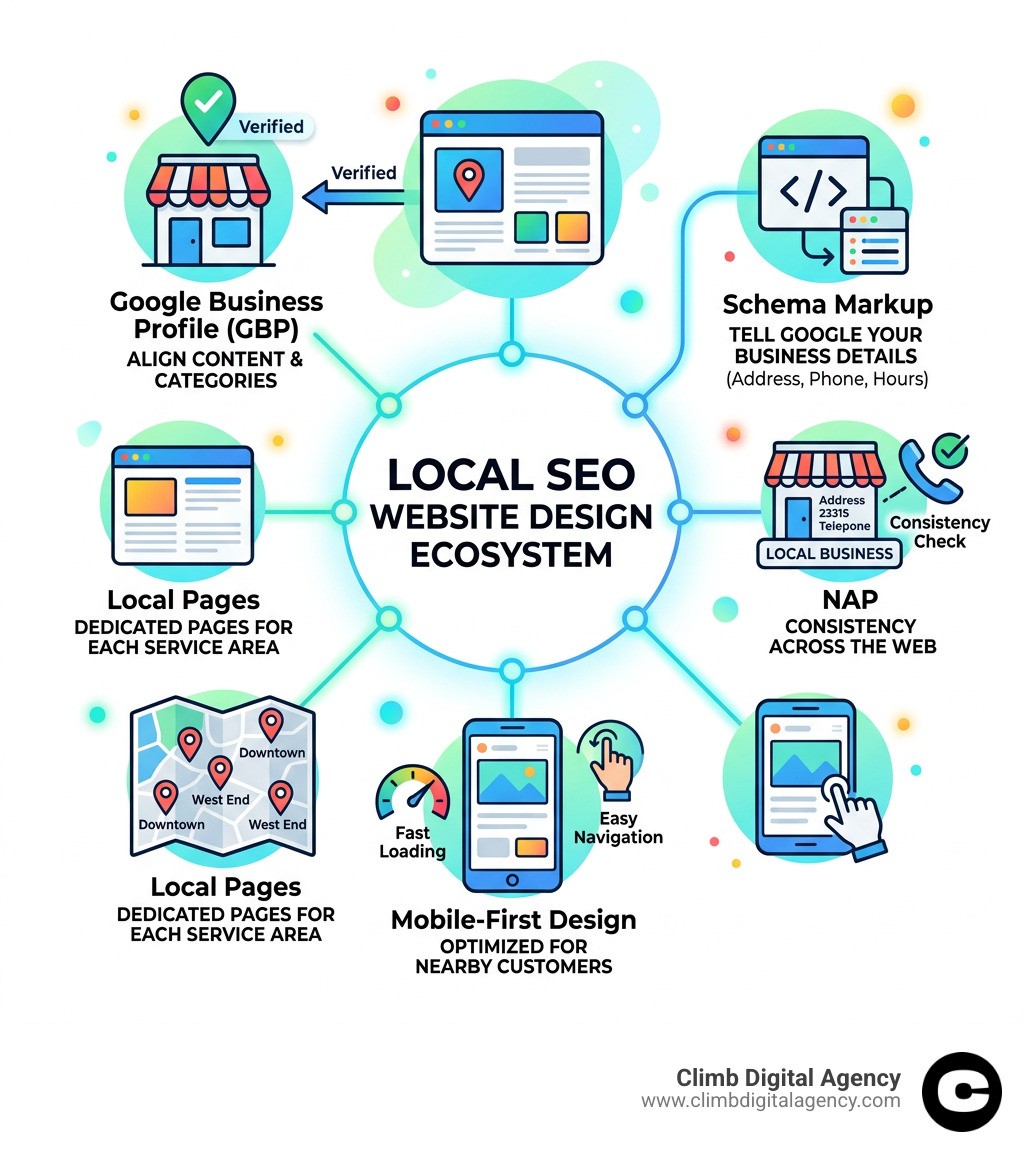
The Architecture of Local SEO Website Design
When we sit down to map out a new project at Climb Digital Agency, we don’t just think about colors and fonts. We think about "Information Architecture." This is the blueprint of your website. For local businesses, this blueprint must serve two masters: the human user who wants to find your phone number in three seconds, and the Google bot that needs to understand exactly which neighborhoods you serve.
Effective local SEO website design relies on a hierarchy that flows from broad to specific. Think of your website as a tree. The trunk is your homepage (the authority hub), the branches are your main service categories, and the leaves are your specific location or "hyperlocal" landing pages.
If your navigation is cluttered or your internal linking is broken, Google’s "crawlers" get lost. If they get lost, they can’t index your pages. If they can’t index your pages, you don’t exist in the search results. We prioritize a clean, logical flow that ensures no important page is more than two clicks away from the homepage. This approach doesn't just help SEO; it dramatically improves conversion rates because users don't have to go on a treasure hunt just to book a service.
Explore our full range of bespoke digital services to see how we build high-performing structures.
Structuring Your Homepage for Local SEO Website Design
Your homepage is your digital storefront's "Main Street." It needs to scream relevance the moment it loads. In local SEO website design, your homepage should be optimized as a local authority hub.
First, your H1 tag (the main heading) shouldn't just say "Welcome to Our Company." It should be a power statement: "[Primary Service] in [City] | [Your Unique Selling Proposition]." For example: "Emergency Plumbing in Chicago | 24/7 Local Experts."
We also recommend aligning your homepage content with your Google Business Profile (GBP) categories. Google allows you to select up to 10 categories on your profile. A common mistake is ignoring these on the actual website. We suggest creating dedicated sections on your homepage for your top 3-5 services, using about 300-400 words for each. This creates a strong topical "scent" for search engines.
Don't forget trust signals. Since 98% of consumers use the internet to find information about local businesses, your homepage must feature your NAP (Name, Address, Phone) clearly—usually in the footer—and include a few stellar local reviews to build immediate credibility.
Creating High-Converting Service and Location Pages
If you serve multiple cities or neighborhoods, a single homepage isn't enough. You need hyperlocal landing pages. These are dedicated pages designed to rank for specific geographic queries like "Roofing contractor in [Neighborhood Name]."
The secret here is ‘siloing' the content. By creating a "silo" or a cluster of related pages, you demonstrate deep expertise. For a multi-location business, this means having a main "Locations" page that links out to individual city pages.
Each city page must have unique content. Do not just swap the city name and keep the rest of the text the same—Google views this as "doorway pages," which can lead to penalties. Instead, mention local landmarks, neighborhood-specific challenges (like "common plumbing issues in historic [Neighborhood]"), and embed a custom Google Map for that specific branch. This level of detail tells Google you aren't just a national brand pretending to be local; you are a genuine part of the community.
Technical Foundations: Mobile-First and Schema Integration
You could have the most beautiful website in the world, but if it takes six seconds to load on a 4G connection, your local ranking will tank. Google has moved to "mobile-first indexing," meaning it judges your entire website based on how it performs on a smartphone.
Implementing Local Business Schema and Structured Data
Schema markup is like a "secret language" that we use to talk directly to search engine bots. It’s a piece of code (specifically JSON-LD) that sits behind the scenes. For local businesses, the LocalBusiness markup is non-negotiable.
This code tells Google exactly what your business is, your hours of operation, your price range, and even your latitude and longitude. By including properties like areaServed, you define your geographic boundaries. This is also how you get those "star ratings" to show up in search results via aggregateRating schema.
In the era of AI search and voice assistants (like Siri and Alexa), schema is more important than ever. These AI tools rely on structured data to provide quick answers. If your schema is correctly implemented, your business is much more likely to be the one the AI "cites" as the best local option.
Optimizing for Mobile-First Local SEO Website Design
Statistics show that 60% of local searches happen on mobile devices. When someone is searching for "coffee near me" while walking down the street, they aren't looking for an immersive desktop experience. They want a phone number they can tap and a map they can follow.
In our local SEO website design process, we prioritize:
Click-to-Call Buttons: Making your phone number a prominent, tappable button in the header.
Fast Loading: Aiming for under 3 seconds. Every second longer results in a massive drop in conversions.
Easy Navigation: Ensuring buttons are large enough for "fat fingers" and menus are simple to toggle.
On-Page Optimization and Content Strategy
On-page SEO is where you bridge the gap between technical structure and the words your customers actually use. It’s about more than just "keywords"; it's about "intent."
Feature | Local SEO Focus | National SEO Focus |
|---|---|---|
Keywords | "Plumber in Austin" | "How to fix a leak" |
Content | Local events, city guides | General industry tips |
Backlinks | Local chamber of commerce | High-authority tech blogs |
Intent | Immediate service/visit | Information gathering |
Mastering NAP Consistency and Local Citations
NAP stands for Name, Address, and Phone number. It sounds simple, but it’s the "silent ranking killer." If your website says "Suite 100" but your Yelp listing says "Ste. 100" and your Google profile says nothing at all, Google gets confused. Confusion leads to lower trust, and lower trust leads to lower rankings.
According to BrightLocal’s 2023 Local Consumer Review Survey, nearly all consumers use the internet to find local business info. Consistent citations across the web (directories like Yellow Pages, Yelp, and industry-specific sites) act as "votes of confidence" for your business's existence and location.
Integrating Reviews and Local Backlinks into Design
Reviews are the lifeblood of local business. A PowerReviews report on consumer reviews highlights that 95% of consumers consult reviews before making a purchase.
In your local SEO website design, don't just hide reviews on a "Testimonials" page. Integrate them into your service pages. If you're a landscaper, show a review from a customer in a specific city right on that city's landing page.
Furthermore, "local backlinks"—links from other local businesses, news sites, or community blogs—are 10x more powerful for local rankings than a generic link from a national site. We recommend sponsoring a local little league team or partnering with a local charity; these often result in a high-quality local link that signals your community authority to Google.
Advanced Tactics for Dominating Local Search
Once you have the basics down, it’s time to look at the "1% strategies" that the big players use.
Geo-Grid Tracking: Traditional rank trackers tell you where you rank in a city. Geo-grid trackers (like Local Falcon) show you where you rank block by block. You might be #1 right next to your office but #10 three miles away. This data allows us to adjust the content on your site to target those "weak" spots.
Programmatic SEO: If you serve 50 different suburbs, writing 50 pages manually is exhausting. Programmatic SEO uses templates and data to create high-quality, unique pages for every ZIP code or neighborhood, ensuring you capture every "near me" search.
Dynamic Content: Imagine a visitor from "Neighborhood A" lands on your site and the headline automatically says "The #1 Rated Service in Neighborhood A." This level of personalization sky-rockets conversion rates.
Google Business Profile Optimization: Your website and your GBP should be in a constant "conversation." Optimizing your Google Business Profile by posting regular updates and photos—and then reflecting those same updates on your website—creates a unified signal that Google loves.
Frequently Asked Questions about Local Web Design
How often should I update my local SEO-optimized website?
We recommend a "monthly maintenance" mindset. At a minimum, you should update your site whenever your services, hours, or locations change. However, for the best results, adding a fresh local blog post or a new set of project photos once a month signals to Google that your business is active and engaged with the community.
Do I need separate pages for every city I serve?
Yes, if you want to rank in those cities. Google’s local algorithm is hyper-sensitive to proximity. If you only have one page for "Chicago," you will struggle to rank for "Naperville" or "Evanston." Creating dedicated pages with unique, local content for each major service area is the most effective way to expand your digital footprint.
What are the most common local SEO design mistakes?
The "Big Three" are:
Inconsistent NAP: Having different addresses or phone numbers across the web.
Slow Mobile Speed: Losing customers before the page even loads.
Generic Content: Using the same "About Us" text as every other competitor in the country instead of highlighting your local roots.
Conclusion
Building a website today is easy; building a local authority hub is a strategic endeavor. At Climb Digital Agency, we believe that your website should be your hardest-working employee—one that never sleeps, handles thousands of customer inquiries, and perfectly represents your brand to the local community.
By focusing on a structured hierarchy, technical excellence like schema and mobile optimization, and a content strategy rooted in local relevance, you don't just "get a website"—you build a lead-generation machine. We are committed to creating long-lasting brands and climbing together to exceed your goals.
Elevate your local presence with our expert services and let's start your climb to the top of the map pack today.