Branding
What "Branding a Company" Actually Means (And Why It Matters)
Learn how branding shapes perception, builds trust, and drives business growth.

Juan Gómez
•
8 min

Branding a company is the ongoing process of shaping how your business is perceived — by customers, employees, and the market at large.
It's not just a logo. It's not just your colors or your tagline. It's every impression your business makes, every time it makes one.
Here's a quick breakdown of what branding a company involves:
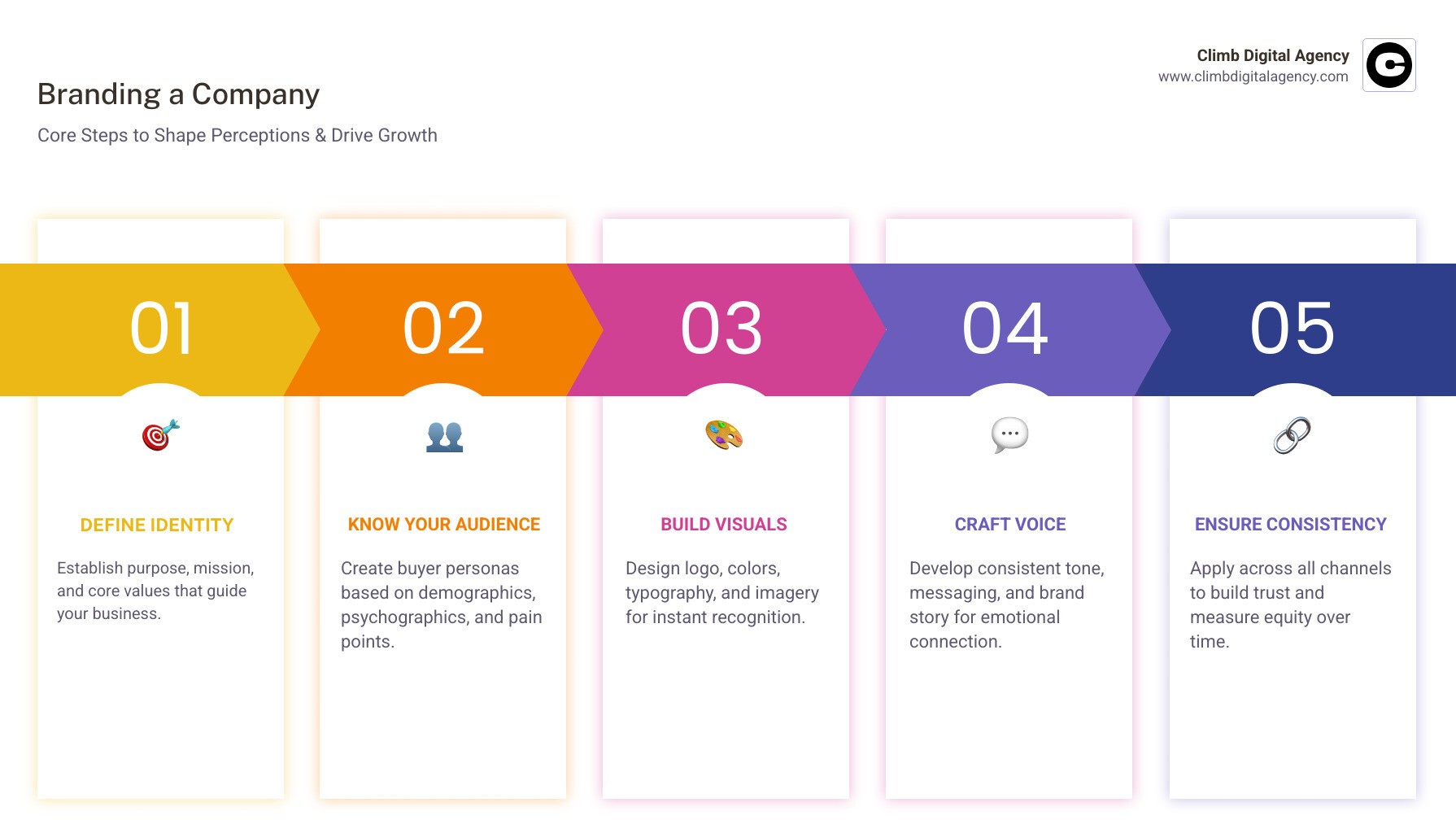
Define who you are — your purpose, mission, and values
Identify your audience — who you're trying to reach and what they care about
Develop your visual identity — logo, colors, typography, and imagery
Shape your brand voice — how you sound in every message you send
Tell your story — the narrative that connects your business to real people
Stay consistent — across every channel, platform, and customer touchpoint
Build trust over time — through promises made and kept
Manage your reputation — actively, not reactively
Measure your brand equity — track how people perceive and value your brand
Evolve when needed — refresh or rebrand as your business grows
Most small business owners think of branding as something big companies do. But that's a myth.
Whether you're a one-person operation or a growing team, your brand is already forming in people's minds — with or without your input. The question is: are you shaping it, or leaving it to chance?
As one widely-cited definition puts it, branding is "the perpetual process of identifying, creating, and managing the cumulative assets and actions that shape the perception of a brand in stakeholders' minds." In other words, it never stops — and it touches everything.
This guide cuts through the noise and gives you a clear, practical path to building a brand that actually works for your business.
Why Branding a Company is the Foundation of Business Growth
When we talk about branding a company, we aren't just talking about aesthetics; we are talking about your bottom line. At its core, your brand is your promise to your customer. It tells them what they can expect from your products and services, and it differentiates your offering from your competitors’.
Branding directly impacts business valuation. Take Apple, for example, which held the highest brand valuation globally in 2022, estimated at a staggering $947 billion. While most of us aren't running global tech giants, the principle remains: a strong brand is a financial asset. It allows you to charge premium prices because customers aren't just buying a commodity; they are buying the trust and status associated with your name.
Beyond the balance sheet, branding is a powerful engine for customer acquisition. Research shows that 82% of consumers make purchase decisions with purpose in mind. When your brand stands for something, people don't just buy from you—they buy into you. This clarity also boosts employee pride and engagement. When your team understands the "why" behind the work, they become brand ambassadors, which fosters marketplace trust.
To understand how this works in practice, it helps to distinguish branding from marketing. While they are two sides of the same coin, they serve different functions:
Feature | Branding | Marketing |
|---|---|---|
Focus | Who you are (Identity) | What you do (Promotion) |
Timeline | Long-term (Building value) | Short-term (Driving sales) |
Goal | Loyalty and Recognition | Leads and Conversions |
Impact | Shapes perception | Drives action |
At Climb Digital Agency, we believe that marketing might get a customer through the door once, but branding is what keeps them coming back for a lifetime. You can learn more about our philosophy on our About page.
Building Your Strategic Foundation
Before you pick a color palette or sketch a logo, you need a strategy. This is the "DNA" of your business. A brand strategy isn't a document you write once and hide in a drawer; it's the blueprint for every decision you make.
Start by defining your brand purpose. Why does your company exist beyond making a profit? For instance, Patagonia’s purpose is to save our home planet. This clarity informs their mission (what they do every day) and their vision (where they want to be in the future). From there, you craft your value proposition—the unique benefit that only you provide.

Defining the target audience for branding a company
You cannot be everything to everyone. In fact, trying to appeal to everyone is a fast track to being ignored by everyone. Defining your target audience is about identifying the specific group of customers most likely to buy from you.
We recommend creating detailed buyer personas that look at:
Demographics: Age, gender, location, and income.
Psychographics: Values, interests, and lifestyle choices.
Pain Points: What keeps them up at night? What problem are they trying to solve?
Understanding these attributes allows you to tailor your brand to speak their language. If your audience is 40% female (like Nike's), your messaging and imagery should reflect that demographic's specific goals and challenges.
Crafting a memorable brand story
Data informs, but stories stick. According to research from Harvard professor Gerald Zaltman, 95% of purchasing decisions happen in the subconscious mind. This means your audience is making gut-level decisions based on how your brand "feels."
A great way to structure this is the "Hero-Guide" framework found in the book Building a StoryBrand. In this narrative, your customer is the hero, not your company. Your company is the guide (think Gandalf or Obi-Wan) who provides the plan and the call to action to help the hero win the day. This emotional connection transforms a transaction into a relationship and makes your brand promise feel real.
Developing a Cohesive Visual and Verbal Identity
Once the strategy is set, it’s time to give your brand a face and a voice. This is your visual identity. It’s the "memory anchor" that helps people recognize you in a crowded feed.
Essential elements for branding a company effectively
A strong visual identity is more than a "pretty" logo. It requires a systematic approach to several key elements:
Logo Design: Your logo should be simple, scalable, and memorable. If you're just starting, you can explore Canva’s templates for logos to get a feel for different styles, but eventually, you'll want something custom that truly represents your USP.
Color Psychology: Colors evoke specific emotions. Green often signals health and trust, while blue suggests stability. Tools like Hubspot’s color palette generator can help you find harmonious combinations.
Typography: The fonts you choose speak volumes. A sleek sans-serif font feels modern and tech-forward, while a traditional serif font feels authoritative and established.
Brand Voice: This is your brand's personality in written form. Are you witty and clever like Taco Bell’s Twitter feed, or authoritative and minimalist like Apple?
To keep all of this organized, you must create a style guide for your brand. This document ensures that whether a freelancer is writing a blog post or an intern is making a social media graphic, the brand looks and sounds the same.
Ensuring consistency across all touchpoints
Consistency is the "golden rule" of branding a company. Inconsistency signals unreliability. If your website looks sleek and modern, but your invoices look like they were made in 1995, you chip away at the trust you've built.
This is especially true in our digital-first world. With over 6.04 billion internet users globally, your brand needs to translate beautifully across mobile apps, social media, and desktop sites. Every touchpoint—from your email signature to your packaging—is an opportunity to reinforce your identity. We take great pride in helping our clients achieve this; you can see our branding work to see how we bring consistency to life.
Managing and Evolving Your Brand Over Time
Branding isn't a "set it and forget it" project. It’s a living entity. As your business grows, you need to manage your brand equity—the commercial value derived from consumer perception.
We recommend active reputation management. This involves:
Social Listening: Monitoring what people say about you on platforms like Reddit or X.
Net Promoter Score (NPS): Asking customers how likely they are to recommend you to others.
Customer Feedback: Using tools like SurveyMonkey or TypeForm to gather direct insights.
When to consider a rebrand or refresh
Sometimes, a brand needs to change. This could be due to a merger, a shift in market trends, or simply because the original look has become dated.
There is a big difference between a "refresh" and a "full rebrand." A refresh is like a coat of paint—updating the logo or fonts while keeping the core strategy. A full rebrand is a total overhaul of the identity and strategy.
A classic example of a successful strategic move is the Dunkin’ rebrand. By dropping "Donuts" from their name, they signaled they were more than just a breakfast stop—they were a beverage-led brand. Following this change, the company was privately sold at a valuation of $106.50 per share in 2020, a 50% increase in just two years.
However, rebranding is risky. Tropicana’s 2009 rebrand, which removed the iconic orange-with-a-straw, led to a 20% sales drop in just two months because customers no longer recognized the product. The lesson? Never change just for the sake of change.
Frequently Asked Questions about Branding
What is the difference between a brand refresh and a full rebrand?
A brand refresh is a tactical update. You might modernize your logo, tweak your color palette, or update your tagline, but your core mission and target audience stay the same. A full rebrand is a strategic pivot. It often involves a new name, a new mission, and a complete visual overhaul to reach a new market or distance the company from a previous reputation.
How do you measure the ROI of branding a company?
While branding is a long-term play, you can track its success through:
Brand Awareness: Increases in direct website traffic and branded search volume.
Customer Loyalty: Higher retention rates and lower acquisition costs.
Price Sensitivity: The ability to maintain or increase prices without losing customers.
Revenue Growth: A 2021 report showed that 68% of businesses saw 10-20% revenue growth attributed to consistent branding.
What are the most common branding mistakes to avoid?
The most frequent mistake is inconsistency—using different logos or tones across different platforms. Other pitfalls include:
Ignoring Research: Basing your brand on what you like rather than what your audience needs.
Being Generic: Failing to define a clear USP that sets you apart from competitors.
Neglecting Internal Branding: Forgetting to train your team on your brand values and voice.
Overcomplicating: Trying to say too much at once. A simple, clear message is always more memorable.
Conclusion
Branding a company is a journey, not a destination. It requires deep self-discovery, rigorous research, and a commitment to consistency. But the rewards—customer loyalty, increased business value, and a team that believes in your mission—are well worth the effort.
At Climb Digital Agency, we specialize in creating long-lasting brands that don't just look good but drive strategic growth. We believe in climbing together with our clients to exceed their goals and navigate the complexities of the digital landscape.
If you’re ready to stop leaving your reputation to chance and start building a brand that resonates, we’re here to help. Start your branding journey with us today, and let’s build something extraordinary together.